I Tested 3 Roblox Hair Stack Extension Methods: Here’s the One I’d Use Again

The hairstyle I wanted did not look complicated.
I had a longer base hairstyle in mind, with a separate fringe to soften the front and a smaller accessory to add volume around the back. In theory, it should have taken less than a minute.
Instead, every time I selected a second hairstyle, Roblox removed the first one.
That sent me into a surprisingly confusing mix of tutorials, browser extensions, old forum posts, and conflicting claims. Some guides said stacking hair was still possible through Roblox’s Advanced editor. Others insisted that I needed a Roblox hair stack extension. Several users reported that methods that had worked for months suddenly stopped functioning after an avatar-editor update.
The terminology was not much clearer. Searches for Roblox multiple hairs, virtual hair extensions, and even stack hair Roblox extension frequently led to the same small group of methods—but with very different claims about what each method could accomplish.
I decided to compare three approaches:

- Roblox’s built-in Advanced Asset ID method
- BTRoblox’s enhanced avatar interface
- RoPro’s avatar tools and sandbox workflow
My goal was not simply to find the method with the most features. I wanted to identify the approach that was repeatable, understandable, reasonably safe, and least likely to fail after Roblox changed its website.
A Note About How I Evaluated These Methods
This comparison was conducted as a structured workflow audit. It should not be interpreted as a guarantee that every method will behave identically on every Roblox account.
I reviewed Roblox’s official avatar-customization instructions, compared the available extension documentation, examined recent development reports, and checked community discussions about equipping multiple hair accessories.
I also separated two outcomes that are often treated as though they are identical:
- Previewing several items together
- Successfully saving those items to a live Roblox avatar
That distinction matters because Roblox frequently changes its avatar editor, asset classifications, and accessory restrictions. Extension developers also acknowledge that certain features may stop working temporarily after Roblox updates its platform. [7]
The extension availability and documentation referenced in this article were reviewed on June 25, 2026.
Why I Decided to Test Roblox Hair-Stacking Methods
My original assumption was that this would be a simple browser-extension comparison.
That assumption was wrong.
The phrase Roblox hair stack extension sounds like the name of a specific program. In practice, people use the phrase to describe several different solutions.
Some players want a browser extension that improves Roblox’s avatar controls. Others only need to know how to enter multiple Asset IDs through Roblox’s existing Advanced editor. Another group wants a sandbox where they can experiment with aesthetic Roblox hair combinations before spending Robux.
Those are three separate goals.
To compare the methods fairly, I evaluated them using five criteria.
1. Saving Reliability
Could the method do more than display a temporary preview?
A useful hair-stacking workflow should ultimately allow the combination to be saved to the user’s live Roblox avatar.
2. Ease of Use
Did the method make the process genuinely easier, or did it merely move the complexity into another interface?
3. Privacy and Account Exposure
Did the workflow require additional browser permissions, third-party services, or unnecessary access to Roblox pages?
4. Resistance to Platform Updates
Was the method based on Roblox’s native controls, or was it closely dependent on a specific version of Roblox’s website interface?
5. Control Over the Finished Appearance
Could I evaluate clipping, hairline alignment, color consistency, and the avatar’s appearance from multiple angles?
These criteria eventually changed my conclusion. The option with the most attractive interface was not automatically the method I trusted most for saving an outfit.
What I Tested
Method 1: Roblox’s Built-In Advanced Asset ID Editor
I started with Roblox’s native method because it did not require third-party software.
Roblox’s official browser-customization documentation explains that users can select Advanced in the Avatar Editor and enter Asset IDs when they want to exceed a category’s normal soft limit. Roblox states that the Advanced interface can accept up to ten asset entries in total. [1]
This corrected one of the biggest misconceptions I found in older tutorials: a browser extension is not always required to wear additional avatar accessories.
How the Advanced Asset ID Method Works
The basic workflow is:
- Open Roblox in a desktop browser.
- Navigate to the Avatar Editor.
- Open the Marketplace page for each hairstyle or accessory.
- Copy the numeric Asset ID from each item’s URL.
- Return to the Avatar Editor.
- Open the relevant hair or accessory category.
- Select Advanced.
- Paste each Asset ID into a separate field.
- Save the combination.
- Select Redraw if the avatar preview does not update immediately.
For example, in a URL such as:
roblox.com/catalog/62234425/Brown-Hair
the Asset ID is:
62234425
This workflow is also discussed in third-party guides covering how to equip multiple hairs on Roblox, although those guides correctly note that current category restrictions may still prevent certain combinations from saving. [3]
What I Expected
I expected the native method to be inconvenient but dependable.
That expectation was mostly accurate.
Copying several Asset IDs is slower than selecting visible thumbnails. It becomes particularly tedious when comparing many combinations because the Advanced editor is not designed as a dedicated styling workspace.
However, the native method has one major advantage: the final save request remains inside Roblox’s own system.
There is no additional extension interpreting the avatar page, no external subscription, and no need to grant a browser add-on permission to access Roblox.
The Limitation I Initially Overlooked
The Advanced editor is official, but that does not mean every hair combination will be accepted.
Roblox distinguishes between different accessory categories. According to its Marketplace policy, complete hairstyles generally belong in the Hair category, while partial hairstyles—such as bangs or braids—may be categorized as Hair, Hat, or Face accessories. [2]
This helps explain why one combination may save while another visually similar combination fails.
Two items can both look like hair while being classified differently behind the scenes.
The practical lesson is that hair layering techniques depend partly on asset classification, not merely on appearance.
A full hairstyle combined with partial bangs may be easier to manage than three full hairstyles competing for the same accessory category and physical space.
Method 2: BTRoblox as a Roblox Hair Stack Extension
BTRoblox was the most obvious candidate when I started researching browser-based solutions.
Its Chrome Web Store listing describes it as an extension that modifies Roblox’s website and adds functionality to the platform’s standard interface. [4]
Its source code and issue tracker are also publicly available on GitHub, which provides more transparency than an extension distributed only through an unofficial download page.
I initially expected BTRoblox to be the clear winner because it improves several parts of Roblox’s website experience.
That conclusion became less certain after examining how closely browser extensions depend on Roblox’s current interface.
What BTRoblox Does Well
BTRoblox can make Roblox’s web interface easier to navigate.
For someone who already uses the extension, its additional controls may reduce the friction involved in finding, previewing, and equipping avatar items.
This is where a browser extension can provide genuine value.
Roblox’s Asset ID method is functional, but it is not elegant. A more convenient interface can make the process easier for users who frequently modify their avatars.
BTRoblox also has an established Chrome Web Store listing rather than relying exclusively on third-party installation files. [4]
What Changed My Opinion
The main issue was not necessarily the extension itself. The problem was its dependence on Roblox’s platform behavior.
Recent BTRoblox development reports have included avatar-related problems, such as accessory-display failures and avatar limits returning after Roblox changes. [5]
An open issue does not mean that every user will experience the same failure.
However, it demonstrates that a browser extension cannot permanently guarantee the removal of limits enforced by Roblox’s backend.
That was one of my biggest false assumptions.
I initially treated an extension as though it could independently decide how many hair items Roblox would save. In practice, an extension can improve an interface or alter how a request is submitted, but Roblox still controls the final avatar rules.
My Verdict on BTRoblox
BTRoblox can be useful as an interface enhancement, but I would not install it solely to solve one hair-stacking problem.
Its value is stronger for players who already use several of its Roblox website features and understand that occasional breakage is part of relying on an unofficial website modification.
For a one-time Roblox character customization task, Roblox’s native Advanced editor involves fewer moving parts.
Method 3: RoPro’s Avatar Sandbox and Editor Tools
RoPro approaches the problem differently.
Its official website lists avatar-related features such as quick item equipping, avatar-editor customization, body controls, and an Avatar Sandbox for testing item combinations. [6]
That made it one of the more appealing options for experimenting with complex outfits.
What I Expected
I assumed the best previewing tool would also be the best tool for producing a finished avatar.
That was another mistaken assumption.
A sandbox and a live avatar editor solve related but distinct problems.
A sandbox helps users visualize item combinations. That is useful when testing expensive accessories or building an aesthetic Roblox hair combination from several separate items.
However, a successful sandbox preview does not necessarily prove that Roblox will accept the same combination when it is saved to the live avatar.
Where RoPro Was Most Useful
RoPro appeared most valuable as a planning environment.
Before purchasing several hairstyles, a player may want to determine:
- whether the fringe disappears into the base hairstyle;
- whether two hairlines overlap;
- whether the back of the avatar looks incomplete;
- whether the hair colors match;
- whether the hairstyle clips through hats or headphones;
- whether the combination works with the intended avatar head and body.
These questions are difficult to answer by viewing individual Marketplace thumbnails.
Roblox provides a native Try On function for many Marketplace items, which should be checked before purchasing. [11]
A more advanced sandbox can still be useful when comparing several potential combinations.
The Important Caveat
RoPro states that it is not endorsed, sponsored, or affiliated with Roblox. Its changelog also notes that features may change because Roblox regularly modifies its platform. [7]
This does not mean that RoPro is inherently unsafe or unreliable.
It simply establishes an important boundary: third-party extensions depend on systems they do not control.
My final assessment was that RoPro is strongest for exploration and previewing, while Roblox’s native editor remains the better reference point for determining whether a combination can actually be saved.
What Surprised Me During the Comparison
Several conclusions contradicted my expectations.
The Extension Was Not the Most Important Part
I began with the question:
Which extension lets me equip the most hair?
The more useful question became:
Which workflow helps me create a combination that Roblox will accept and that still looks intentional?
No extension can guarantee a result when Roblox’s own validation system rejects the accessory combination.
This is one reason older tutorials can appear to work perfectly while current users report errors. The tutorial may have been accurate when it was produced, but Roblox’s platform behavior later changed.
Previewing and Saving Are Different Tests
A hairstyle combination can look correct in a sandbox without being accepted by the live avatar editor.
Likewise, items may appear equipped on the website but fail to update immediately in the avatar preview.
Roblox’s own support documentation recommends using the Redraw option when an avatar thumbnail does not update correctly. [1]
I therefore separated the test into two questions:
- Can the combination be previewed?
- Can Roblox save and render it consistently?
Only the second question determines whether the workflow is complete.
More Hair Did Not Usually Produce Better Hair
Another incorrect assumption was that better customization meant stacking as many items as possible.
In practice, the strongest combinations generally followed a clear visual hierarchy:
- one primary hairstyle;
- one secondary layer for shape or volume;
- one optional detail, such as bangs, braids, or a small accessory.
Once multiple full hairstyles compete for the same space, clipping becomes more visible and the silhouette becomes harder to understand.
The most effective hair layering techniques were compositional rather than numerical.
Item Categories Matter More Than Their Names
Two Marketplace assets may both include the word “hair” in their names, yet one may be categorized as a Hair accessory while another partial hairstyle may use the Hat or Face category.
Roblox’s Marketplace rules permit partial hairstyles to be assigned to several possible accessory categories. [2]
Users should therefore not judge compatibility from an item’s name alone.
The underlying category can influence whether the combination is accepted by the editor.
Browser Extensions Add a Security Decision
Installing an extension is different from visiting an ordinary website.
Google advises users to install only extensions they trust and review the permissions requested during installation. Chrome also allows users to restrict an extension so that it can access only selected websites. [8]
Roblox’s Terms of Use similarly explain that third-party services are not controlled or endorsed by Roblox and may operate under separate policies. [9]
For younger players, installing a browser extension should involve a parent or guardian, particularly when the extension requests permission to read or modify data on Roblox pages.
What Actually Worked Best
For most users attempting to equip Roblox multiple hairs, I would begin with Roblox’s native Advanced Asset ID editor.
It is not the most visually impressive option.
It is simply the method with the clearest balance of control, privacy, and long-term practicality.
Why I Prefer the Native Method
The native method keeps the workflow inside Roblox.
It does not require an additional extension to read or alter the website.
It is documented by Roblox itself.
It also exposes the Asset IDs directly, making the process easier to understand and troubleshoot.
Most importantly, it reveals the real limitations sooner.
If Roblox rejects a combination, installing another interface may not change the underlying result.
The Workflow I Would Use Next Time
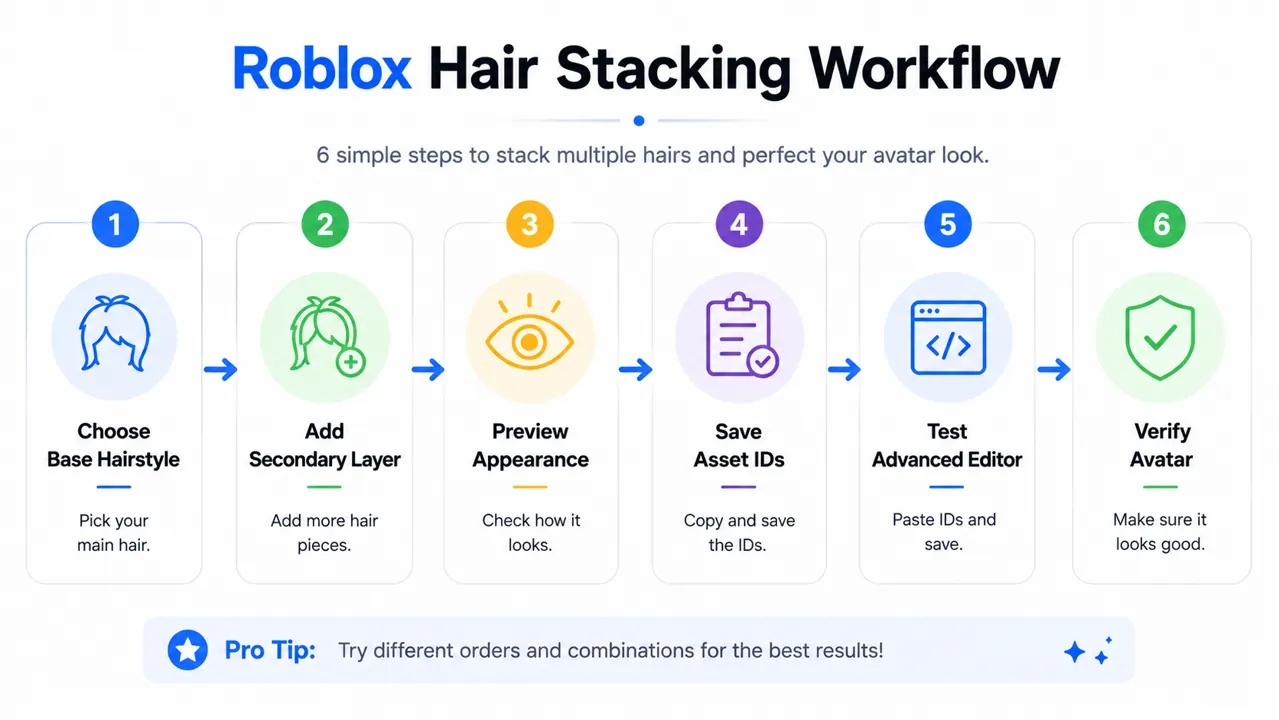
Step 1: Select One Base Hairstyle
Choose the hairstyle responsible for most of the avatar’s silhouette.
Examples include:
- long waves;
- a short bob;
- a high ponytail;
- curly hair;
- straight layered hair;
- a tied-back style.
Do not begin by purchasing four separate hairstyles and assuming they will fit together.
Step 2: Add One Functional Secondary Layer
The second item should solve a specific visual problem.
For example:
- bangs to improve the front;
- back strands to add length;
- side pieces to frame the face;
- a bun or ponytail attachment;
- braids to introduce texture.
This is a more effective use of virtual hair extensions than stacking two unrelated full hairstyles.
Step 3: Preview Before Spending Robux
Use Roblox’s Try On function where it is available. [11]
An avatar sandbox can provide additional context, but the native preview should still be checked because it is closer to Roblox’s actual rendering environment.
Inspect the avatar from the front, side, and back whenever possible.
Step 4: Record Every Asset ID
Open each selected item in a separate browser tab and save its Asset ID.
Keeping the IDs in a temporary note prevents repeated searching if the editor reloads.
Step 5: Test Roblox Advanced First
Enter the Asset IDs into Roblox’s Advanced editor and attempt to save the combination. [1]
If Roblox accepts it, redraw the avatar and verify the result inside an experience.
Step 6: Use an Extension Only for a Specific Benefit
An extension may be reasonable when:
- you already use it for several Roblox website features;
- you want a better preview or outfit-building interface;
- you have verified the publisher and permissions;
- you understand that it may stop working after a Roblox update.
I would not install several similar Roblox extensions simultaneously.
Doing so makes troubleshooting more difficult and increases the number of tools that have access to Roblox pages.
Hair Layering Techniques for More Aesthetic Roblox Hair
The technical workflow is only half of the problem.
A combination can save successfully and still look poorly assembled.
The following techniques produced the clearest styling logic.
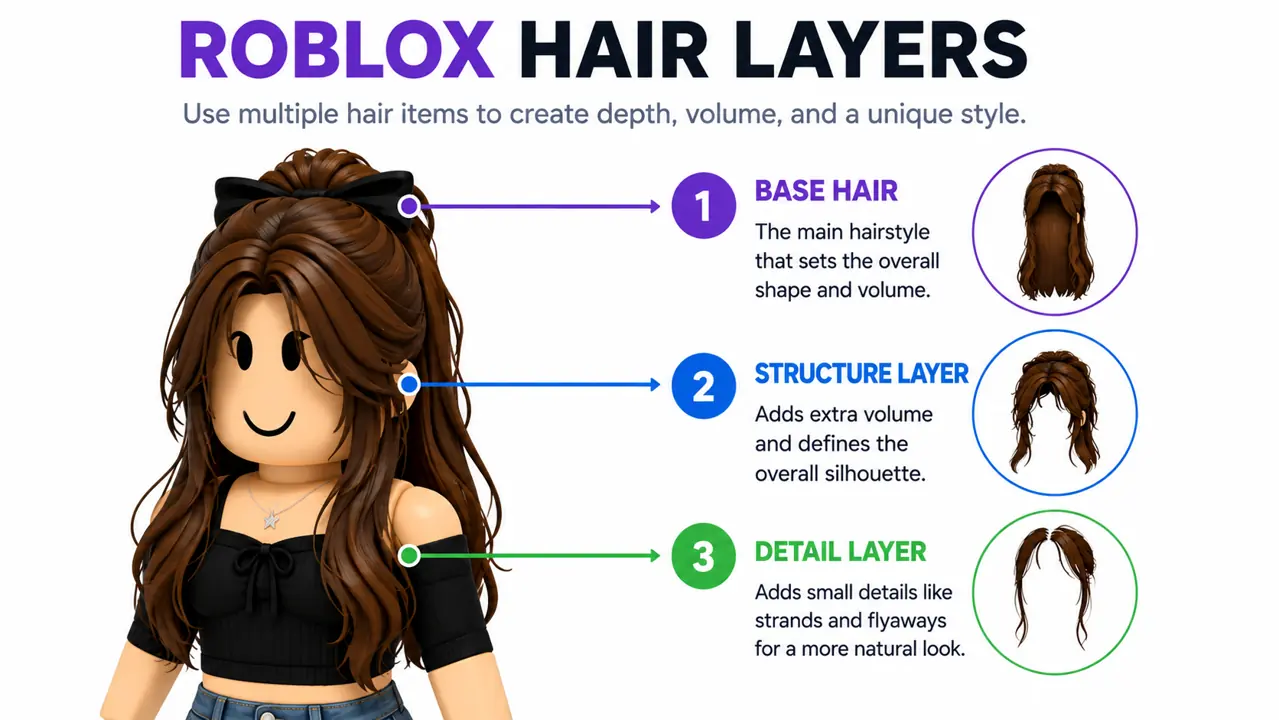
Use a Base, Structure, and Detail System
Treat the hairstyle as three possible layers.
Base: The main mass of hair.
Structure: A secondary item that changes the shape, such as bangs, a ponytail, back strands, or a bun.
Detail: A smaller accent such as clips, ribbons, loose strands, or braids.
Not every avatar needs all three.
In many cases, a base and one structural layer are sufficient.
Match Hairlines Before Matching Length
A slight difference in color may be tolerable. Conflicting hairlines are normally much more noticeable.
Check whether:
- both items expose the same part of the forehead;
- one fringe cuts through another;
- the sideburn areas overlap;
- the base hairstyle leaves a visible gap near the face.
Avoid Combining Two Dominant Silhouettes
A large curly hairstyle and a large spiked hairstyle may each look effective separately.
Together, they often appear accidental.
At least one layer should remain visually subordinate to the other.
Check Colors Under Different Lighting
Marketplace previews do not always show how an item will appear inside a Roblox experience.
Two assets described as black may use different textures, shading, or highlight intensity. These differences can become more visible under bright game lighting.
Leave Room for Other Accessories
Hair is only one component of the avatar.
Headphones, hats, glasses, ears, horns, masks, and other head accessories can intersect with layered hairstyles.
Using every available slot for hair may reduce the avatar’s flexibility elsewhere.
Troubleshooting Common Roblox Hair-Stacking Problems
Selecting a Second Hair Removes the First One
This frequently occurs when both items are selected through the standard category interface.
Use Roblox’s Advanced editor and enter the Asset IDs manually instead. [1]
Roblox Says Only One Hair Accessory Is Allowed
This may indicate a category restriction, account-level editor behavior, or recent platform update.
Remove one item and test the combination again.
You should also check whether one of the partial hairstyles belongs to another accessory category.
Do not assume that a browser extension can permanently override a restriction enforced by Roblox.
The Combination Works in a Sandbox but Not on My Avatar
A sandbox may be displaying a visual simulation rather than confirming that Roblox will save the outfit.
Return to Roblox’s native Avatar Editor and test the Asset IDs through Advanced.
The Avatar Preview Is Blank or Outdated
Use Redraw, reload the page, or allow the thumbnail time to regenerate. [1]
When the issue starts after installing an extension, disable extensions one at a time. Roblox notes that browser add-ons can contribute to general website problems. [10]
The Advanced Button Is Missing on Mobile
The Roblox mobile application and desktop browser do not always provide identical avatar controls.
Use the full Roblox website in a desktop browser.
A mobile browser’s desktop-site mode may expose more controls, although its layout can still vary.
An Extension Suddenly Stops Working
Check:
- the official Chrome Web Store listing;
- the developer’s changelog;
- recent GitHub issues;
- whether the extension has been updated;
- whether Roblox recently changed its avatar pages;
- whether another extension is interfering.
Avoid downloading replacement files from random video descriptions, file-sharing services, or websites imitating the official extension page.
Safety Checklist Before Installing a Roblox Extension
Before installing a Roblox hair stack extension or another avatar tool, check the following:
- Is it listed in an official browser-extension store?
- Does the publisher match the recognized developer?
- Has the extension been updated recently?
- Does it explain why its permissions are necessary?
- Can its website access be limited to Roblox?
- Does it provide a privacy policy?
- Does it have an established support or development history?
- Does it request information unrelated to its stated function?
A browser extension should never require users to enter their Roblox password into an unofficial popup or third-party webpage.
Google allows Chrome users to review, restrict, disable, and remove extensions through the Manage Extensions page. [8]
Which Roblox Hair-Stacking Method Should You Choose?
Choose Roblox Advanced When:
- you want the method with the least third-party exposure;
- you only need to create one or two outfits;
- you are comfortable copying Asset IDs;
- you want to test Roblox’s actual saving limits.
Consider BTRoblox When:
- you already use its broader website features;
- you prefer an enhanced Roblox interface;
- you are willing to troubleshoot occasional compatibility problems;
- you have reviewed its current permissions and development status.
Consider RoPro When:
- your priority is previewing item combinations;
- you want to compare items before purchasing them;
- you already use its other avatar or server features;
- you understand that sandbox compatibility does not guarantee a successful live-avatar save.
For most users, the most practical sequence is:
Preview the combination → Test Roblox Advanced → verify the saved avatar → install one trusted extension only when it provides a clear additional benefit.
Final Takeaways
The most important lesson was that the best Roblox hair-stacking workflow is not necessarily the one promising the greatest freedom.
Extensions can improve the experience, but they remain dependent on Roblox’s interface, platform rules, and asset validation. A Roblox update can make a previously reliable method temporarily obsolete.
The native Advanced Asset ID method is the option I would use again because it keeps the process understandable.
It also makes failures easier to diagnose: Roblox either accepts the combination or rejects it.
I would still use an avatar sandbox when planning a complex look, particularly before spending Robux. However, I would treat that sandbox as a design tool rather than proof that the outfit can be saved.
Next time, I would also begin with fewer items.
One strong base hairstyle and one carefully chosen secondary layer usually create a more coherent result than stacking every compatible asset.
The objective is not simply to prove that an avatar can wear multiple hairs. It is to make the final hairstyle look as if it was intentionally designed that way.


Leave a Reply